Deck staining after power washing protects your NJ wood deck by preventing moisture, mould & mildew growth, ultra-violet (UV) rays, and surface deterioration. Power washing makes the deck vulnerable by weakening lignin, opening pores, and removing the natural oils.
Deck staining after power washing is important to protect untreated wood from mold and mildew growth, seasonal stress, and extreme humidity.
You should wait 24 to 72 hours after power washing before staining your deck. The exact time of staining the deck after power washing depends on moisture levels, weather conditions, and wood type. Staining the deck too soon, or a damp deck, can trap moisture inside the wood, leading to peeling, uneven color, and reduced protection.

Deck Staining After Power Washing
The 5 steps of deck staining after power washing include surface prep, protection of the surrounding area, light sanding, and application of 1st and 2nd coat. DIY deck staining is time-consuming, cost-effective, and only best for small to medium-sized decks. Always hire a professional deck staining service in NJ for a large wooden deck that requires heavy repair and prep work.
Professional deck staining offers the best value for money, delivering long-term results and a sleek finish.
Does Deck Staining After Power Washing Protect Your Wood Deck?
Yes, deck staining after power washing protects your wood deck. When you power wash a deck, it removes dirt, mold, and old coatings while opening up the wood pores. This leaves the surface highly vulnerable to moisture, sunlight, and environmental damage. Applying stain afterward restores protection and prevents long-term deterioration.
How Does Deck Stain after Power Wash Protect Your Deck?
Deck staining after power washing protects your deck by creating a moisture barrier, UV protection, surface stabilization, and mould & mildew resistance.
Listed below are 4 ways that deck stain after power washing protects your deck.
- Moisture Barrier: Deck stain acts like a moisture barrier. Stain penetrates the wood and reduces water intake. Deck staining after powerwashing prevents warping, swelling, and rotting, especially in New Jersey, where excess humidity and frequent rain require extra wood protection.
- UV Protection: Deck stains with pigments provide ultimate UV protection. Sun exposure breaks down wood fibers, leading to a grey, weak deck. Staining protects the structural integrity of wood while keeping the deck looking fresh for years to come.
- Surface Stabilization: Deck staining stabilizes the surface by regulating moisture levels inside the wood. Untreated wood expands and contracts due to repeated wet-dry cycles. This expansion and contraction cause wood to crack and split before its age. Deck staining reduces surface stress and prevents premature aging.
- Mold & Mildew Resistance: Deck staining protects wood decks from mold and mildew. A bare deck is an ideal breeding ground for mold growth, especially in high-humidity areas. Quality stains have anti-mildew additives that prevent algae buildup, slippery surfaces, and black spots.
Why Staining After Power Washing Is Critical for NJ Decks?
Deck staining after power washing is Critical for NJ decks because power washing exposes the wood grain to biological growth, UV radiation, and moisture. Your deck is left unprotected against the harsh seasonal conditions of New Jersey without staining.
What Power Washing Does to Wood Fibers?
Power wash removes dirt, old coatings, and contamination from the wood. It affects the wood grain structure by opening the wood pores, increasing porosity. Power washing strips away natural oils and weakens the binding component in wood fibers, known as lignin. The surface of the wood deck may become rough after the power washing.
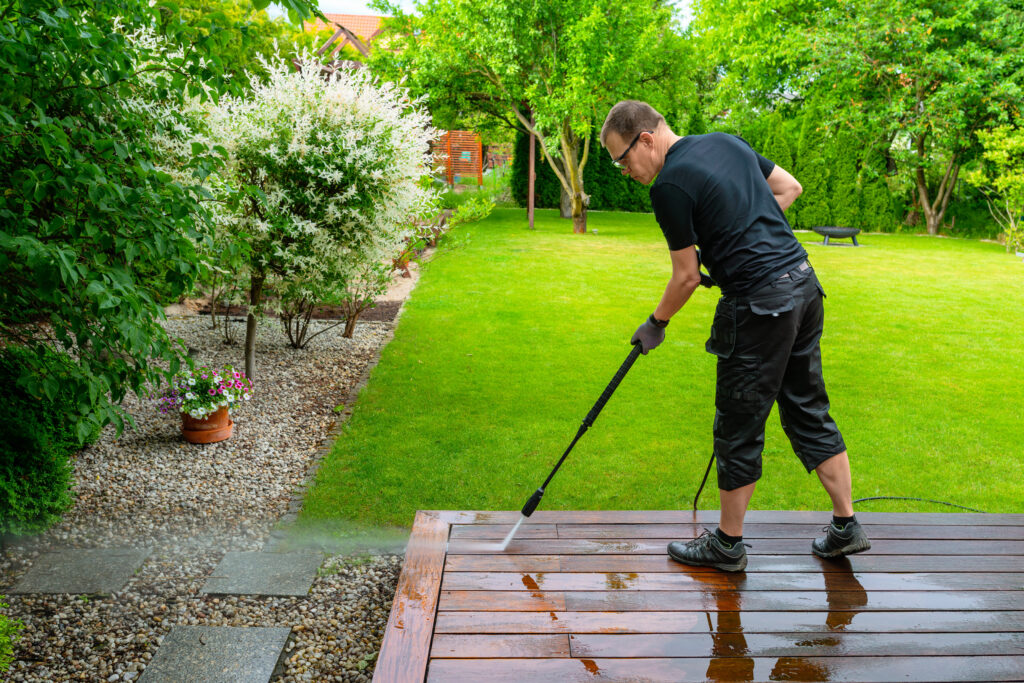
Power Washing A Deck in NJ
How does NJ Climate Impact on Unprotected Decks?
NJ climate leaves negative impacts on unprotected decks such as surface degradation, corrosion, cracking, and splitting of wood fibers.
Freeze-Thaw Cycles: Wooden decks absorb moisture that freezes and expands in the colder months, leading to cracking and splitting of wood fiber. Cold NJ climate accelerates long-term structural damage.
Coastal Salt exposure: Wood decks near coastal areas in NJ have salt in the air, which increases moisture retention in the wood. High moisture retention degrades the wood deck surface and accelerates corrosion.
What Factors Affect Wood Deck Drying Time after Power Washing in NJ?
The 5 factors affecting the wood deck drying time after power washing in NJ include humidity levels, temperature, sunlight exposure, wood type, and washing intensity.
The 5 factors that affect wood deck drying time are listed below.
- Humidity Levels: Damp air slows down evaporation and increases drying time. The drying time of a wood deck increases after power washing in New Jersey due to the high humidity.
- Temperature: Cold weather slows the deck’s drying after power washing. The ideal drying temperature for a wood deck is 60°F – 85°F
- Sunlight Exposure: Direct sunlight speeds up the drying process, while shaded decks take longer than expected.
- Wood Type: Softwoods (pine, cedar) have a long drying time because they absorb more water. Hardwoods (oaks, maple) absorb less water and take less drying time.
- Washing Intensity: Powerwashing with high PSI or excessive water use results in deeper saturation and longer drying time. Light water cleaning leads to quick drying.
How to Know Your Deck Is Ready for Staining?
Look for visual signs, perform a water drop test, and use a moisture meter to determine whether your deck is ready for staining.
The 3 methods to know your deck is ready for staining are listed below.
- Look for Visual Signs: Even color, no visible moisture, and a dry-to-the-touch wood are the 3 visual signs that indicate the deck is ready for staining.
- Perform the Water Drop Test: Sprinkle a few drops of water on the deck. Your deck is ready for staining when water drops quickly. Your deck is too wet if water beads up on it
- Use Moisture Meter: Use a moisture meter to confirm that the wood is dry and ready for draining. The ideal moisture content is below 12-15 percent.
What Happens If You Stain Too Soon?
Applying stain too soon before the deck dries can lead to poor absorption, an uneven finish, trapped moisture that can cause mold growth, and flaking within months. You should wait 2 to 3 days after powerwashing to ensure that the deck is dry enough for staining. Deck stain lasts for years when applied at the right time.
How to do Deck Staining after Power washing?
You can do deck staining after power washing by following 5 steps: surface prep, light sanding, protection of the surrounding area, and application of the first and second coats.
Listed below are 5 steps for deck staining after power washing to protect a NJ wood deck.
Step #1 Prep the Surface
Prepare the wood deck surface by removing leaves, debris, and dust. Make sure that the deck is fully dry after 24 to 72 hours of power washing. Do not stain a damp deck, as it prevents proper absorption and can lead to peeling.
Step #2 Do Light Sanding
Do light sanding to smooth the surface, especially when the surface feels rough due to raised grains. Sanding after power washing a deck improves finish and stain penetration. Do not skip sanding rough wood, as it leads to a poor appearance and uneven stain application.
Step # 3 Protect Surrounding Areas
Protect surrounding areas like siding, railings, plants, and concrete by using plastic sheeting or tape. Stain splash leaves a permanent mark on the surrounding areas, so do not ignore this step.
Step # 4 Apply the Stain
Apply the stain along the wood grain with a brush, roller, or sprayer. A brush is the best applicator because it offers deep penetration and control. You can use it to cover small areas and edges. Rollers are the best choice for large, flat surfaces. A sprayer is a good choice only if you have experience applying stain with it. Do not apply the stain in direct sunlight, as the stain will dry quickly. Avoid overapplying and backbrushing after spraying
Step #5 Apply a Second Coat
Apply a second coat of stain if the manufacturer’s instructions require a second coat. Apply a second coat when the first coat is absorbed, not fully dry. Do not apply too many coats, as this leads to build-up and peeling rather than protection.
What is the difference between DIY and hiring a Professional Deck Staining Service in NJ?
The difference between DIY and hiring a professional deck staining service lies in cost, deck size, experience, and time. Hiring a professional deck-staining service costs more than DIY, but a professional completes the work more quickly and with greater precision. DIY is a good choice for a small to medium-sized deck in good condition, while professional deck staining is a must for large decks that require heavy prep work and repairs. The time required to complete DIY deck staining is longer than for a professional service because a DIYer doesn’t have the proper tools or experience. Homeowners in NJ should choose a professional deck-staining service for a flawless finish with long-lasting protection. DIY deck saves money, but a DIYer needs to do proper surface prep and product selection to achieve the best deck staining results.
FAQs
How long after power washing can you stain a deck?
Within 24 to 72 hours after power washing, you can stain a deck.
What Happens If You Don’t Stain After Power Washing?
If you don’t stain a Deck after powerwashing, then wood absorbs moisture, UV damage accelerates, mould and mildew return, and the deck’s lifespan shortens.
Can I stain a damp deck?
No, you can not stain a damp deck. Moisture blocks proper stain absorption, leading to a blotchy finish and peeling. Always stain a deck after the wood is fully dry.
What happens if it rains after staining?
The stain becomes uneven and requires reapplication if rain starts within 12 to 24 hours. Stain remains safe when rain starts 24 to 48 hours after application.
Do I need to sand after power washing?
Yes, you need to sand after power washing. Light sanding after power washing improves the final finish, improves stain absorption, and smooths the surface.