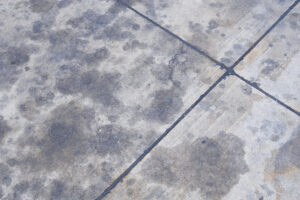
Efflorescence is that salty substance that appears on walls and slabs and sometimes even ceilings, a sign of moisture coming through the surface. By itself, it isn’t a structural defect, but it’s a sign that something’s going on that needs further investigation.
What Efflorescence Actually Is
Efflorescence is the salt that is left on the surface after moisture migrates through your cementitious, blockwork, or brickwork surface. The moisture dissolves salts out of the brickwork, blockwork, or concrete, and when the moisture comes to the surface and evaporates, it leaves behind the salt crystals. This means there’s moisture coming through your surface, and moisture on the other side that needs to be handled and addressed.

How to powerwash bricks and pavers?
Can Pressure Washing Remove Efflorescence?
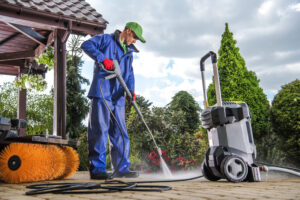
Pressure washing alone cannot permanently remove efflorescence because water activates the soluble salts, making them temporarily disappear until the surface dries and the white powder returns. But pressure washing can help after the treatment.
You’ll know it’s efflorescence when you get it wet and it goes away. If you get it wet and it’s still really white, that could be failed sealer, so you’ve got to do some test spots. If you hit efflorescence with as much pressure as you want, it will not budge, that’s why you need an efflorescence specific chemical.
Efflorescence Is a Sign, Not a Defect
Efflorescence by itself is not a defect, it’s not a problem, it’s a sign of a problem, generally a moisture problem, meaning you need to find that moisture and solve it. If there’s efflorescence on the inside of a retaining wall where you know there’s dirt on the other side, that’s a good sign moisture is coming through the blockwork wall, evaporating, and leaving those salt crystals.
As the owner or person in charge of maintenance, you now know you need to find where that moisture is coming from and solve that issue.
Efflorescence vs. Calcite
Efflorescence and calcite are both salt deposits and calcium that purge and leach out of mortar, brick, and block, and they get really, really hard, so you can’t remove them with a pressure washer alone.
Calcite, on the other hand, shows up when it’s dry, and after you hit it with a pressure washer, it is much more hardy, hard on the exterior, and takes a pretty tough chemical to get off.
How to Properly Treat Efflorescence
Solving the Moisture Issue First
Once a moisture solution has been attempted, it’s time to do some cleaning, taking the efflorescence off the wall. There are good products you can buy from hardware shops to dissolve efflorescence and take it off walls and surfaces, then wait to see if the efflorescence reappears after the moisture issue has been solved.
Wetting the Surface Before Applying Acid
If you’re around an area with a lot of glass, make sure that glass is really wet and keep it wet to try to prevent any acid from getting on there in the first place. With pavers, they’re a little more forgiving, so wet down everything first.
Applying, Brushing, and Rinsing
Use your proper PPE, gloves, and a mask. Put the acid mix on, and when it starts fizzing, that’s when you know it’s working. Let it sit for a couple minutes, then brush it with a broom, rinse, and reapply as necessary, usually taking somewhere between one, two, or three attempts before getting a satisfactory result.
Knowing When to Stop Reapplying
You never want this to dry while treating it. After scrubbing with the broom, let it sit anywhere between a couple of minutes and 15 minutes, then rinse it off, repeating as necessary up to three or four times max. At that point, if it’s not moving after three or four times, it’s probably not going to be removed further.
Cleaning the Right Way
Why Saturating the Brick Matters
The most beautiful brick job can be ruined by a bad cleaning job, so the chemicals you choose and the manner of cleaning are very important. Wetting the wall before adding the cleaner is perhaps one of the most important aspects of cleaning brickwork, since brick is a very porous material.
If you don’t satisfy the thirst of that brick for liquid before adding acid or cleaner, it gets absorbed back into the brick instead of staying on the face to do its job.
Protecting Glass and Metal Surfaces
You can’t put too much water on the face of a brick job before you start cleaning, so thoroughly saturate it, passing over it several times with a hose.
The chemicals in most cleaners can have an effect on some glass, causing it to etch, and some light fixtures and types of metals can also be affected, so it’s a good idea to mask off certain areas while cleaning.